Green turtles recover globally, face local threats
Summary and headline written by AI from the source article. How we work
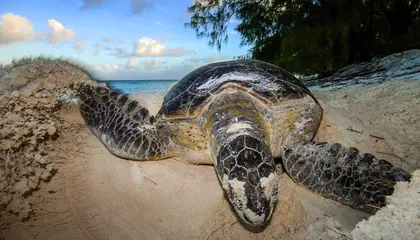
Marine researchers in the western Indian Ocean, including Elke Talma and Jeanne Mortimer, have observed a significant recovery of green sea turtle populations on Aldabra atoll and worldwide.
For decades, green turtles were heavily hunted for their meat and eggs, particularly in the western Indian Ocean where as many as 12,000 were captured annually on Aldabra atoll in the late 19th century.
A hunting ban implemented on Aldabra in 1968, combined with broader conservation efforts, allowed the turtle population to rebound. Researchers now estimate that green turtle numbers have increased by roughly 28 percent since the 1970s, leading the International Union for Conservation of Nature to reclassify the species from “endangered” to “least concern” in October 2025. However, this global recovery masks regional disparities.
While some populations, like those nesting on Aldabra, have seen a 173 percent increase in nests since 1980, reaching over 15,000 clutches in 2019, others in the Pacific and Indian Oceans remain vulnerable. Conservationists like Mortimer caution that the “least concern” designation could create a false sense of security. They highlight that continued threats, such as bycatch, hunting in some areas, and habitat loss from developments like a new resort on Assumption Island, require ongoing monitoring and management.
The health of green turtle populations varies greatly across the Seychelles, with some islands supporting thousands of nesting females while others host only a few.