Fossil analysis challenges assumptions about ancient mammal sex differences
Summary and headline written by AI from the source article. How we work
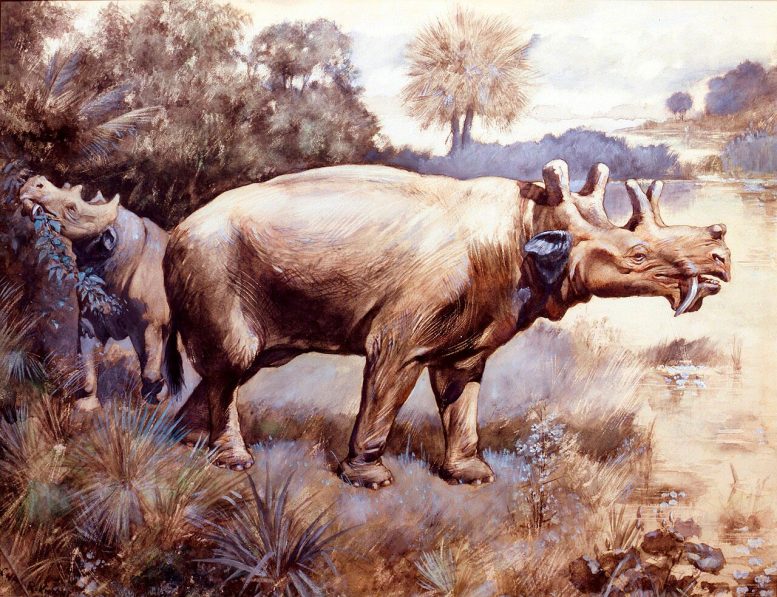
Researchers at the University of Kansas re-examined 30 skulls of Uintatherium anceps, a horned mammal that lived around 58 million years ago, and questioned long-held beliefs about how much males and females of this species differed in size and appearance. For decades, paleontologists believed Uintatherium males were significantly larger with more prominent horns and teeth than females, a classic example of sexual dimorphism. Kevin Mulcahy and K.
Christopher Beard began their investigation while trying to identify a broken tooth found in Montana, which led them to the American Museum of Natural History in New York and its extensive collection of Uintatherium skulls. Mulcahy measured the skulls and found the anatomical variations didn't clearly divide into male and female groups as expected if strong sexual dimorphism existed.
He then compared his findings to modern bison, animals with similar horns and ecology, where sex was known, to test the reliability of his methods. The bison data showed clear differences between males and females, suggesting the statistical tools were effective, but the Uintatherium skulls did not exhibit the same strong pattern. This research suggests that the dramatic differences once assumed between male and female Uintatherium may not have existed, and that historical assumptions influenced earlier interpretations.
Mulcahy argues that strong male-biased sexual dimorphism may not be a common trait inherited from early mammals, but rather something that evolved independently in some lineages, a view supported by recent studies of living mammals.