Scientists redefine fungal genus after finding hidden species
Summary and headline written by AI from the source article. How we work
Researchers led by R.
Yoshioka collected fungal specimens from linden and related trees in Japan and Europe between 2006 and 2024, revealing a far greater diversity within the Splanchospora genus than previously known. For over twenty years, Splanchospora was a poorly understood group of fungi defined by a single characteristic. The team discovered that the genus includes both sexual and asexual forms, allowing them to identify new traits and place Splanchospora within the Neohendersoniaceae family.
Through DNA sequencing and microscopic examination, the scientists determined that what was once considered a single species, Splanchospora ampullacea, is actually a complex of multiple distinct lineages. They identified four new species from Japan, Splanchospora fulviconidia, S. microspora, S. oblongiconidia, and S. pseudomicrospora, each distinguished by subtle differences in its spore shape. Molecular analysis showed variations across five genetic loci, with the greatest differences found in S. fulviconidia.
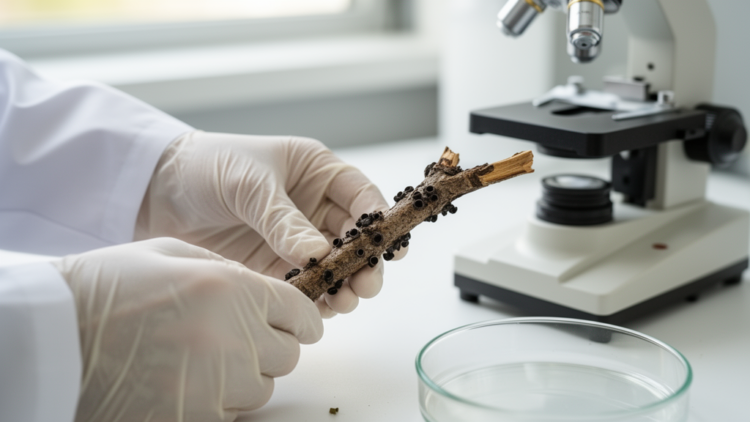
The research team found all six recognized Splanchospora species growing on dead linden twigs, indicating a strong preference for these trees as hosts. They believe similar undiscovered species likely exist in North America and Russia, as previous records may have misidentified distinct fungi as S. ampullacea. The researchers suggest using spore shape alongside DNA analysis to accurately identify species within the genus and further explore fungal diversity.