New armored fish species reveals evolutionary shift in ancient China
Summary and headline written by AI from the source article. How we work
Paleontologists in Yunnan province, China, identified a new species of ancient, jawless fish called Asioaspis brachyotus.
The fish lived roughly 419 million years ago during the Early Devonian period. Asioaspis brachyotus belongs to the Galeaspida, a group of armored fish found only in China and northern Vietnam, and is more closely related to jawed vertebrates, including humans, than to modern jawless fish. Researchers examined fossilized headshields collected near the Miandian Reservoir, finding three nearly complete and three incomplete specimens.
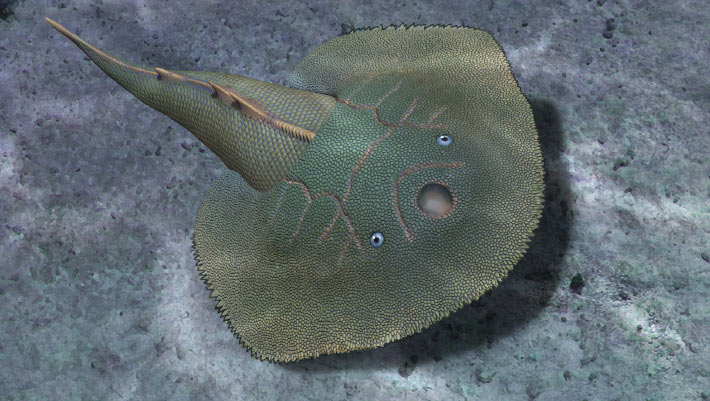
The headshields of Asioaspis brachyotus measured between 4.7 and 6 centimeters long and featured serrated edges and at least 12 pairs of gill pockets. By analyzing the fish’s anatomy, the team determined it occupied a unique position in the evolutionary history of Polybranchiaspiformes, an order within Galeaspida. Earlier members of this order lived partly buried in sand, with sensory openings clustered on the head.
Asioaspis brachyotus had widely spaced openings, a feature that would have prevented it from burying itself in sediment without clogging its mouth and gills. The scientists propose this suggests Asioaspis brachyotus lived on the seafloor surface, representing a transition from a buried to a surface-dwelling lifestyle within the Polybranchiaspiformes order.