Burnt scrolls yield secrets with novel imaging technique
Summary and headline written by AI from the source article. How we work
Researchers at the University of California, Berkeley, developed a method to read charred ancient scrolls without physically unrolling them.
The team recreated carbonized papyrus scrolls similar to those found in Herculaneum, Italy, a Roman town destroyed by the eruption of Mount Vesuvius in 79 AD. These scrolls represent the only complete ancient library known to exist, but attempts to unroll and read them after their 1752 discovery often resulted in fragmentation.
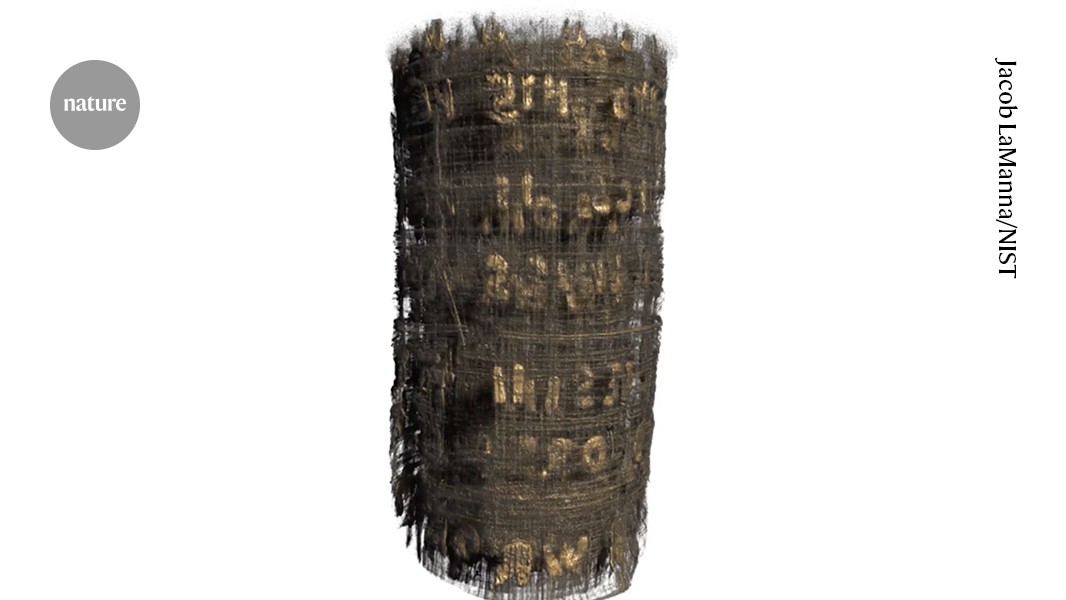
The scientists focused on detecting lead within the ink, as both ink and papyrus contain carbon, hindering standard X-ray imaging. They inscribed papyrus sourced from Egypt with ink containing varying lead concentrations, then carbonized the rolled scrolls in a furnace to mimic the effects of the volcanic eruption. Using neutron and X-ray tomography at the US National Institute of Standards and Technology, they scanned the scrolls as a series of slices and created 3D renderings.
A modified computer program, originally designed to analyze lithium-ion battery coils, then virtually unrolled the scans, allowing the team to decipher the text. Classicist Thomas Coward, at the University of Nottingham, UK, notes this approach could significantly speed up the process of virtually unrolling the fragile Herculaneum papyri. While previous efforts have successfully deciphered portions of scrolls using similar methods and machine learning, this lead-detection technique offers a clearer distinction between ink and papyrus.
Further research aims to unlock the knowledge contained within the remaining unopened scrolls.