Film preserves Western Armenian language and unites diaspora
Summary and headline written by AI from the source article. How we work
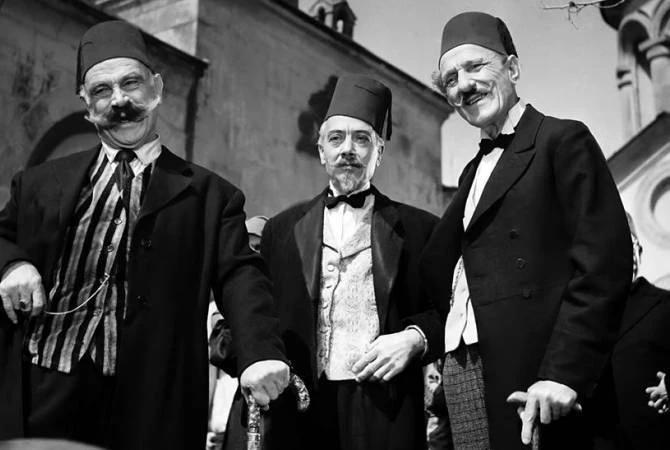
In 1962, Yerevan State Institute of Theatre and Cinematography students Arman and Yervand Manaryan created the short film Dzhvzhig (Fried Liver), a story about a man publicly humiliated by a wealthy merchant’s condescending charity. The filmmakers deliberately avoided the typical Socialist Realism favored by Soviet authorities, choosing instead a tragicomic tale set in 19th-century Ottoman-era Erzurum, Turkey. They reconstructed the setting using Armenian villages and studio sets because filming on location was impossible.
The film centers on Nerses Akhpar, who receives a small gift of liver from Nigoghos Agha, a man who then repeatedly reminds Nerses of his generosity in public. This “toxic charity” drives Nerses to desperation, culminating in a defiant act where he throws a piece of liver back at Nigoghos Agha, asserting his dignity. The Manaryan brothers filmed in black and white to evoke the feel of 19th-century photography and to emphasize the economic differences between the characters.
Beyond its narrative, Dzhvzhig uniquely became the first film produced entirely in Western Armenian, a dialect endangered after the 1915 Armenian Genocide. The filmmakers cast older actors, Hrachia Nersisyan and Tsolak Amerikyan, who were native speakers of Western Armenian, ensuring authenticity. The film resonated deeply both within Soviet Armenia, where it entered the popular vernacular, and among the global Armenian diaspora, providing linguistic validation and a shared cultural connection across continents.