Granite savanna flora in Brazil links to semiarid Caatinga domain
Headline and summary by local AI
Botanists identified that the plant species on a granitic inselberg in Northeastern Brazil are primarily linked to the semiarid Caatinga rather than the core Cerrado savanna.
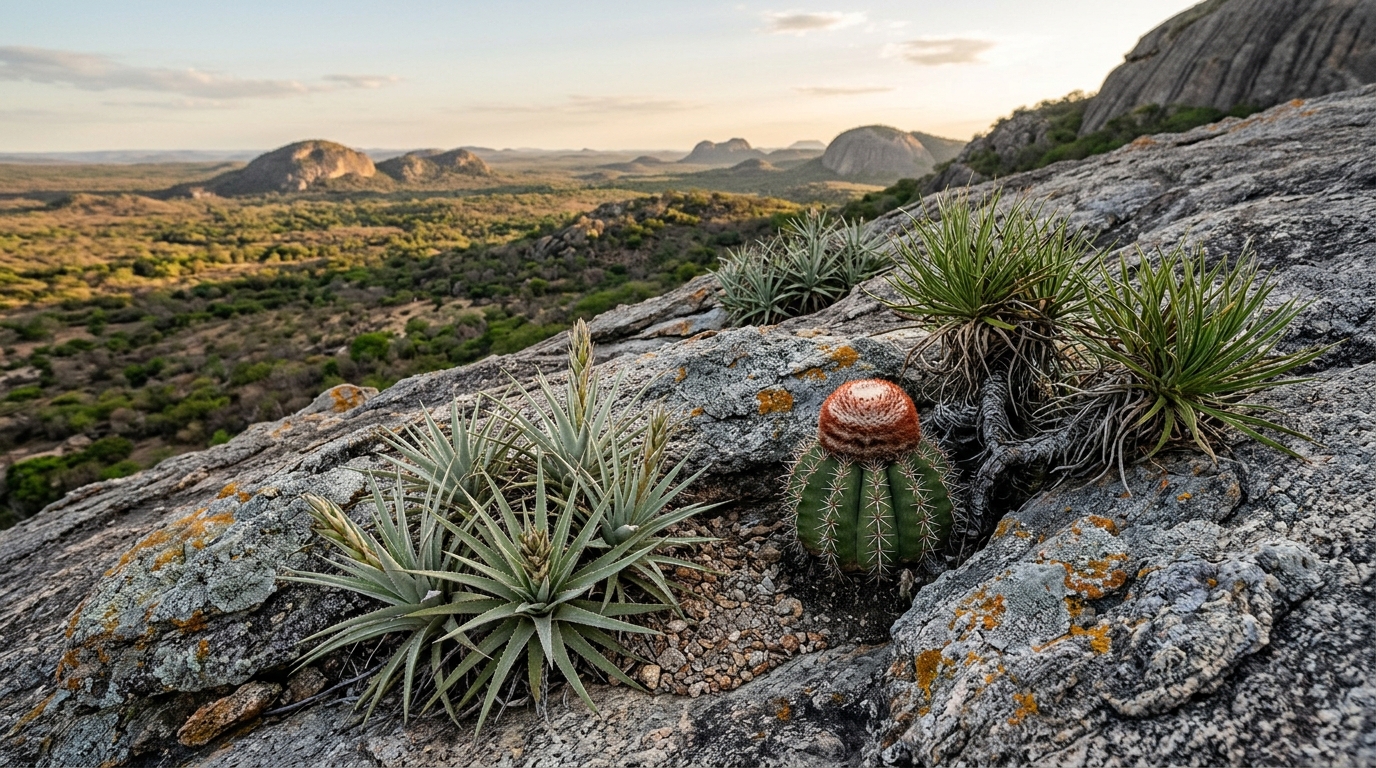
Researchers examined the Serra do Barriga, a large rock formation in the state of Ceará, to determine how its unique landscape influences its plant life. The study revealed that while the landscape looks like a typical savanna, the specific types of plants found there cluster with the Crystalline Caatinga.
Scientists used statistical analysis to compare this site with 29 other regions in Brazil. They found that isolated savanna patches in the Northeast are not one single group of plants. Instead, local geology, such as shallow granitic rocks, acts as a filter that determines which species can grow there. The team found 156 angiosperm species in a 13.18 square kilometer area along the lower slopes of the inselberg.
Most of these plants are therophytes, which are annual plants that survive dry periods as seeds. This characteristic matches the Caatinga environment and differs from the core Cerrado, where perennial plants usually dominate the ground. Researchers noted that the site contains a mix of plants from both the Caatinga and the Cerrado. They also warned that granite quarrying and pasture expansion threaten the area and its rare species.
The team suggested creating a legally protected Natural Monument to preserve the area's unique evolutionary history.
Selected and summarized by local AI How we work
Discovery: Archaeology, new knowledge of art, culture and history, forgotten history uncovered, something lost restored.