Scientists reaffirm Alpine newt’s identity from 1768 description
Summary and headline written by AI from the source article. How we work
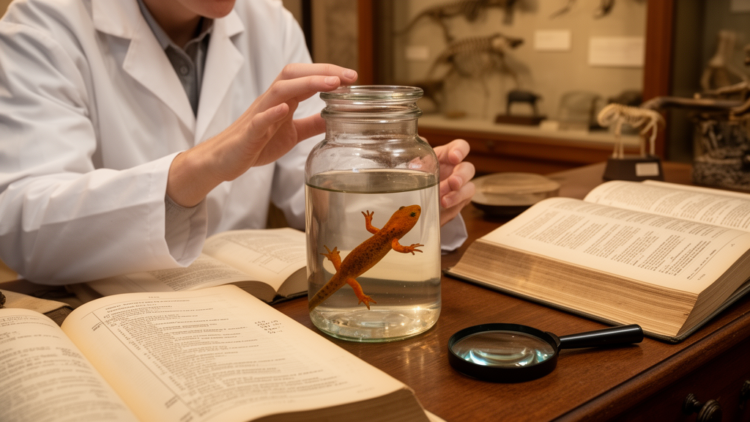
Researchers in Austria reviewed historical records and concluded that Proteus tritonius, a creature Laurenti described in 1768 from a lake on Mount Ötscher, is the larval form of the Alpine newt, Triton alpestris. The investigation stemmed from a 2025 proposal to classify a fire salamander larva as the definitive example, a “neotype”, of Proteus tritonius. The scientists examined Laurenti’s original writing, the likely location he observed, and ecological conditions at the time to support their claim.
They determined that the historical environment around Mount Ötscher was probably too cold for fire salamanders to thrive in 1760, making a fire salamander larva an unlikely match for Laurenti’s description. The review also countered arguments that the creature lived in a difficult-to-reach, lower-altitude body of water, pointing to evidence of trails and pastures indicating easier access to the lake on the mountain.
Laurenti himself initially considered the creature a type of Proteus due to its permanent gills, but acknowledged it might be a larval newt. The researchers found his description of the dorsal fin’s position aligned with the Alpine newt, not the fire salamander. They plan to formally request the International Commission on Zoological Nomenclature to reject the proposed neotype, arguing it violates rules requiring neotypes to align with original descriptions.