Curator suggests artist Jan van Eyck painted himself in famous Portrait
Headline and summary by local AI
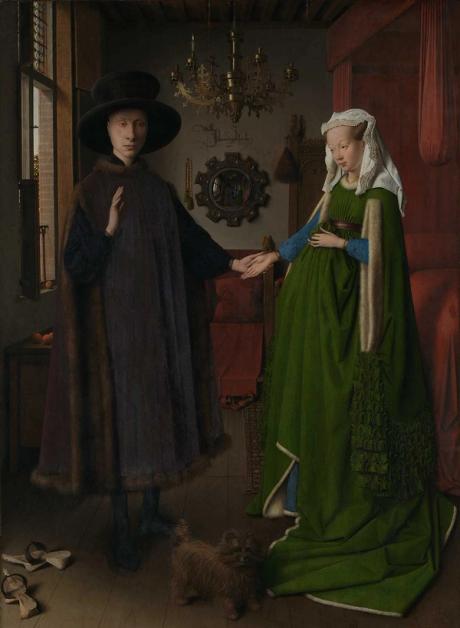
Stephan Kemperdick, a curator at the Berlin Gemäldegalerie, argues that the man in Jan van Eyck's 1434 Arnolfini Portrait is the artist himself and the woman beside him is his wife, Margaret.
Kemperdick presented this theory in a catalogue essay for an upcoming exhibition at the National Gallery in London. The exhibition will display nine of the artist's surviving panel portraits.
Kemperdick bases his theory on the painting's Latin inscription, which reads "Jan van Eyck was here 1434." He argues the large text links the artist directly to the male figure. He also suggests that a historical reference to "hernoul le fin" in a 16th-century inventory was a mocking nickname given by later generations rather than the Italian surname Arnolfini. Additionally, he believes a statue of St Margaret near the woman's head identifies her as the artist's wife.
Other scholars and curators express skepticism toward this identification. Nicholas Flory and Emma Capron of the National Gallery describe the theory as speculative, noting that the woman in a different 1439 portrait of Margaret has greyish-blue eyes, while the woman in the Arnolfini Portrait has brown eyes. Maximiliaan Martens and Till-Holger Borchert also express doubt, maintaining that the inventory reference strongly links the painting to the Arnolfini merchant family.
The debate has wider implications for how museums identify other works by the artist. If Kemperdick is correct, a 1433 portrait at the National Gallery currently identified as a self-portrait would no longer be a self-portrait. The Berlin Gemäldegalerie recently renamed a related work to Portrait of a Man with a Red Chaperon, while the National Gallery will keep the Arnolfini label for the upcoming show.
Selected and summarized by local AI How we work