Archaeologists find 1,500 year old priestess statuette in Japan
Headline and summary by local AI
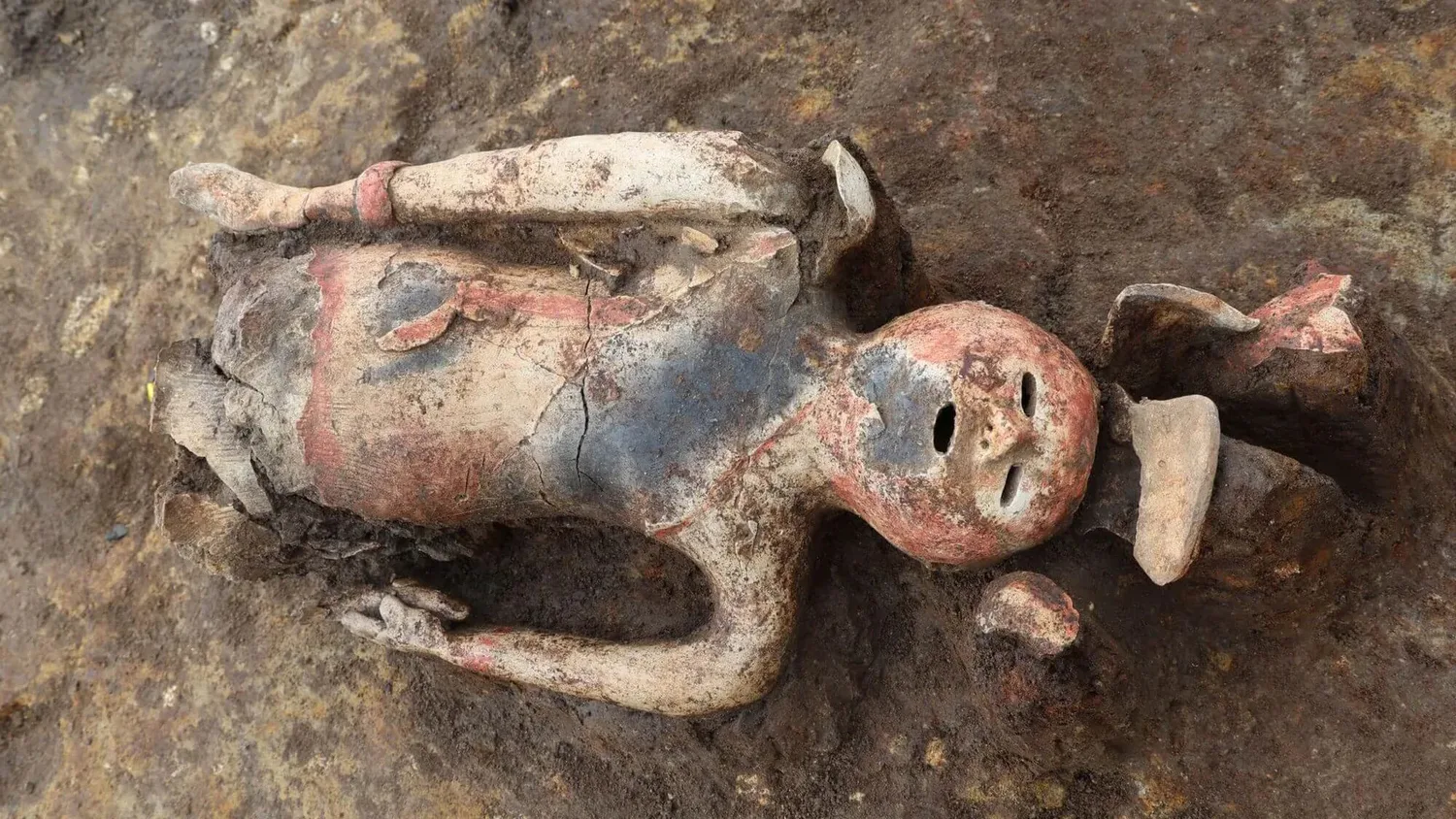
Archaeologists in Gunma Prefecture, Japan, discovered a 5th-century clay figurine depicting a miko, a woman who performed religious rites.
The find occurred during excavations at the Nishikaminomiya site in the city of Isesaki, located northwest of Tokyo. The artifact is a haniwa, a type of clay figure used during funerary ceremonies and placed near burial mounds.
Researchers believe the sculpture dates to the second half of the 5th century AD during the Kofun period, a time when the Japanese nobility built large burial mounds. The figurine features a topknot hairstyle, modeled facial features, and a ritual staff held in its left hand. It also displays bracelets and a sash with traces of red pigment. Experts found the piece in a moat surrounding a burial mound that measures approximately 45 meters.
While the preserved portion of the figurine stands about 40 centimeters tall, researchers suggest it may have originally been much larger. The discovery is unique because it is among the earliest examples of anthropomorphic haniwa found in the Gunma Prefecture. The excavation team has worked at the site since 2020 and has identified 11 burial mounds from the 5th to 6th centuries. Scientists believe the figurine may have originally stood on a platform for ceremonies before falling into the moat.
The study of this artifact helps researchers understand the religious beliefs and funerary traditions of ancient Japanese people.
Selected and summarized by local AI How we work
Discovery: Archaeology, new knowledge of art, culture and history, forgotten history uncovered, something lost restored.
More in Discovery

Architecture of support enables famous figures to overcome physical constraints
disabled-world.com · 12 Nov 2026

A new theory explores how humans assign meaning to physical objects
frontiersin.org · 12 Nov 2026

Tajik designer reimagines ancient Persian epic through modern graphic design
asiaplus.news · 13 Nov 2026