Singapore Hospital uses AI to target brain stimulation for mental health
Summary and headline written by AI from the source article. How we work
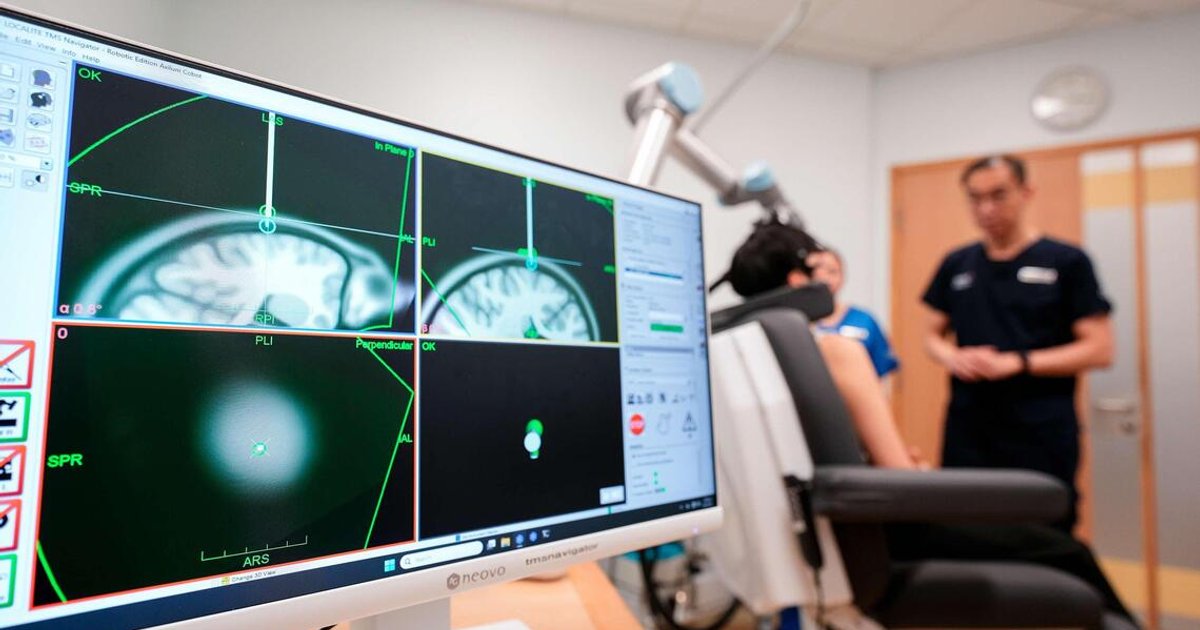
National University Hospital (NUH) in Singapore began offering a personalized Transcranial Magnetic Stimulation (pTMS) service, using fMRI scans and artificial intelligence to pinpoint brain circuits affected by depression and anxiety.
NUH is likely the first hospital in Southeast Asia to offer this targeted treatment, which avoids surgery. The treatment maps individual brain activity to deliver magnetic pulses to specific areas, unlike standard TMS which uses a general approach.
Researchers at NUH have also tested pTMS on severe obsessive-compulsive disorder (OCD) with promising results. One patient with 20 years of OCD experienced a 35% reduction in symptoms after the trial, while another saw a 78% improvement in their scores. Standard TMS is already used in Singapore for treatment-resistant depression and OCD, with studies showing response rates between 21% and 68%. Currently, pTMS at NUH costs $15,000 per treatment and is not covered by subsidies.
The hospital plans to expand the service to other public hospitals, the Institute of Mental Health, Sengkang General Hospital, and Khoo Teck Puat Hospital, with support from a National Healthcare Innovation Centre grant. B1Neuro, a spin-off from the National University of Singapore, developed the brain-mapping algorithm used in pTMS and is facilitating regional collaborations.