Giant birds shaped human evolution through predation
Headline and summary by local AI
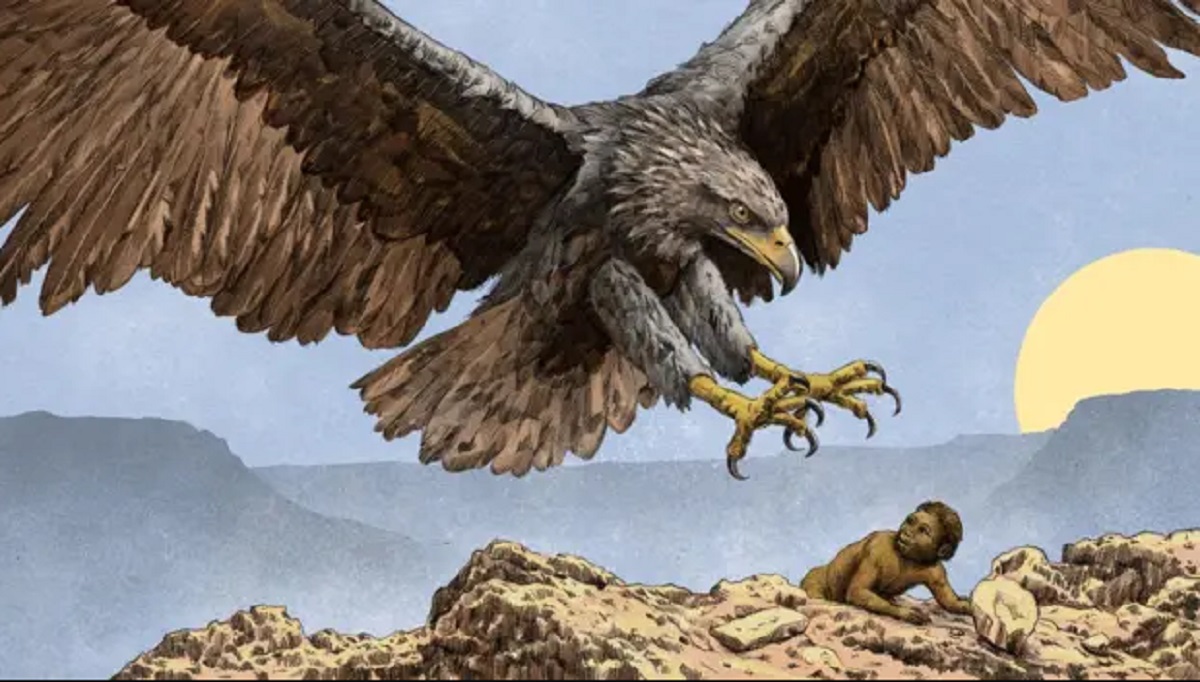
Researchers suggest that predation by giant birds of prey played a major role in shaping human evolution by forcing early ancestors to develop social behaviors and complex communication.
Scott McGraw, a primatologist at the Ohio State University, found that marks on the skull of the "Taung Child," an Australopithecus africanus fossil from 2.8 million years ago, match the claw marks left by eagles.
McGraw compared these marks to those found on more than 600 modern primates killed by birds of prey in the Taï Forest of Ivory Coast. The damage indicates that the birds extracted the eyes from the skulls, a common hunting behavior for raptors to store prey. James Cole, an archaeologist at the University of Brighton, argues that the constant threat from these massive predators forced early humans to adapt.
He suggests that standing upright helped ancestors spot threats from above, while living in larger groups provided safety in numbers. This social structure may have also spurred the development of language. Cole explains that as groups grew, individuals needed ways to coordinate tasks beyond what simple gestures could achieve, especially when communicating about approaching predators. The article also links these prehistoric experiences to global folklore.
Joanne Cooper, a curator at the Natural History Museum in London, notes that giant birds like the Haast eagle of New Zealand or the teratornithids of the Americas likely inspired legends of birds snatching children. These massive birds dominated the skies for nearly 50 million years before disappearing around 11,700 years ago. While humans and these birds eventually competed for resources, their ancient conflict likely left a lasting mark on human biology and culture.
Selected and summarized by local AI How we work
Discovery: Archaeology, new knowledge of art, culture and history, forgotten history uncovered, something lost restored.
More in Discovery

Generative AI and physics data create a roadmap for quantum aesthetics
arxiv.org · 4 Nov 2026

Gender-inclusive language fails to reduce political leadership stereotypes
phys.org · 10 Nov 2026

Interpreters revolutionized simultaneous interpretation during Nuremberg trials
lavanguardia.com · 8 Nov 2026