Dominican peas farmers use work songs to coordinate labor and build community
Headline and summary by local AI
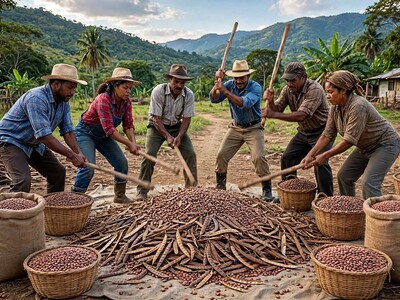
Dominican farmers in rural areas of the Dominican Republic perform the apaleo de habichuelas, a traditional work song and labor practice used to process beans.
Participants gather around a large cloth or tarp where they pile beans in their shells. Workers stand around the pile and use machetes or sticks as mallets to strike the beans. One person leads the group by providing a command voice, while the others respond in chorus.
These vocalizations include rhythmic sounds that mimic the striking of the beans. The workers also perform complex poetic forms such as pareados, cuartetas, and décimas, which tell stories of love and mischief. These songs help the laborers maintain energy, stay motivated, and prevent collective boredom during the long task. The practice serves as a form of mutual aid common in the Dominican Republic and other parts of Latin America.
These types of communal work gatherings are often organized as juntas or convites. The specific melodies used in these gatherings are known as tonadas, and the style of music changes depending on the type of labor being performed. During past cultural festivals in Salcedo, the apaleo de habichuelas attracted large crowds of spectators who joined in the singing. The tradition currently faces changes due to the presence of radio in rural areas.
Many workers now listen to bachata and merengue music from radio stations while they work. This shift has replaced the traditional live singing and communal choruses with recorded music from bands using the güira, tambora, and accordion.
Selected and summarized by local AI How we work

