Public fundraising sent bitten children to France for rabies treatment
Headline and summary by local AI
A crazed dog bit six schoolchildren in Newark, New Jersey, on December 2, 1885, sparking a massive public effort to transport the victims to France for medical treatment.
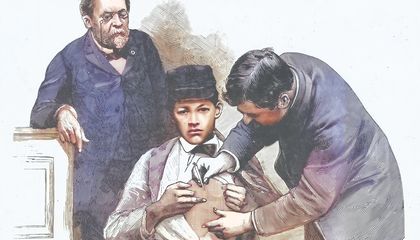
Doctor William O’Gorman wrote an open letter in a local newspaper suggesting that victims of a rabid dog bite should travel to Paris to see Louis Pasteur. Although Pasteur had recently announced a vaccine for rabies, the news had not reached many people in the United States.
O’Gorman appealed to the public to help fund the journey for the children, who faced a likely death sentence if they did not receive the new treatment. The public responded by raising $1,000 to cover the costs of the trip. The New York Herald helped coordinate the fundraising, and a French shipping line provided discounted tickets and onboard housing for the children.
Four of the boys, along with a veterinary scientist and one of the victims' mothers, boarded a steamship to France. They arrived in Paris and spent 11 days receiving injections at Pasteur's laboratory. The successful treatment of the boys helped change how the public viewed medical science. By attaching human drama to the story, the media turned a scientific breakthrough into a national narrative.
This shift encouraged people to see medicine as a field of progress that could be pushed forward by scientific research. Following the boys' return to the United States, independent clinics began to open in several American cities to offer the vaccine locally.
Selected and summarized by local AI How we work
More in Discovery

Indigenous leader Diana Jembuel Morales seeks to create Journalism School in Colombia
lasillavacia.com · 15 Nov 2026

Francesco Queirolo carved a delicate marble net for a sculpture in Naples
mymodernmet.com · 18 Nov 2026
Atmospheric winds transport microbes to polar regions
eldiario.es · 23 Nov 2026