Archaeologists reconstruct face of Roman era man found decapitated in Scotland
Headline and summary by local AI
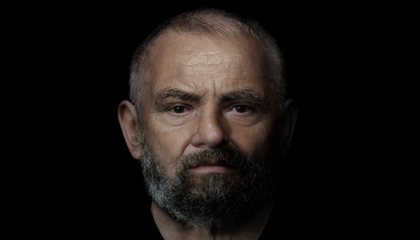
National Museums Scotland and several research institutions have created a digital facial reconstruction of a man who lived in Roman Scotland between 140 and 165 C.E.
The man was part of a group of four individuals whose remains were discovered in Musselburgh in 2010. Archaeologists found that these men had been decapitated after death, though experts remain uncertain if the practice was a religious ritual, a form of punishment, or a precaution to prevent the dead from returning to life.
The reconstruction depicts a man in his early 50s with brown eyes, graying hair, and facial lines that indicate a physically demanding life. Analysis of his skeleton revealed he suffered a broken nose, a rib fracture, and a condition in his right elbow that likely caused septic arthritis. Because of this mobility loss, he used his mouth to pick up objects.
Researchers believe he may have held a noncombat role, such as a clerk, because his condition would have made it difficult for him to wield a sword with his right hand. Isotopic and DNA analyses revealed that the man grew up in southern Britain, hundreds of miles from where he died near the Roman fort of Inveresk. His remains are among the most well-preserved skeletons from that era.
The museum plans to display the digital face alongside his skull in an exhibition in Edinburgh starting in November 2026. This discovery provides a rare look at the diverse inhabitants of the Roman frontier, as the other bodies found with him originated from England and the Mediterranean.
Selected and summarized by local AI How we work