New predator dinosaur discovered after century in museum
Summary and headline written by AI from the source article. How we work
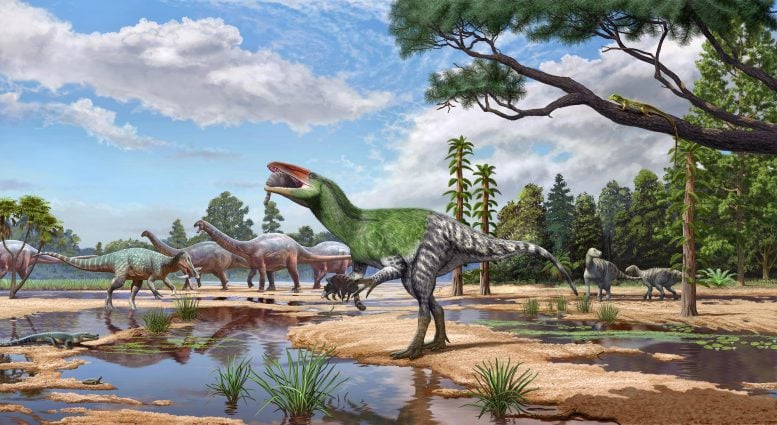
Researchers at University College London (UCL) identified a new dinosaur species, Invictibellatrix amberina, from a fossil discovered on the Isle of Wight in Britain.
The fossil, originally collected in 1924, remained unstudied for nearly 100 years before the team examined it using CT scanning to reconstruct its skull and brain structure.
They determined the dinosaur was a member of the megaraptorans, a group of agile, two-legged meat-eating dinosaurs related to tyrannosaurs, but which hunted using arms and claws rather than powerful jaws. This discovery marks the first confirmed presence of megaraptorans in Europe, filling a gap in the understanding of how the group spread across ancient continents. Scientists previously believed megaraptorans originated in Asia, travelled through Europe, and then reached Gondwana, the ancient supercontinent encompassing present-day Africa, South America, and Antarctica.
The Invictibellatrix fossil proves they lived in Europe before migrating south. The newly identified dinosaur lived approximately 120 million years ago during the Early Cretaceous period and measured three to four meters long. Researchers suggest that while not an apex predator itself, Invictibellatrix would have posed a greater threat to humans than Tyrannosaurus rex due to its size relative to a human’s.
The team used mathematical models combining fossil data, evolutionary relationships, and ancient geography to trace the dinosaur’s history and distribution.


