Researchers identify new lace bug species in Japan's Ogasawara Islands
Headline and summary by local AI
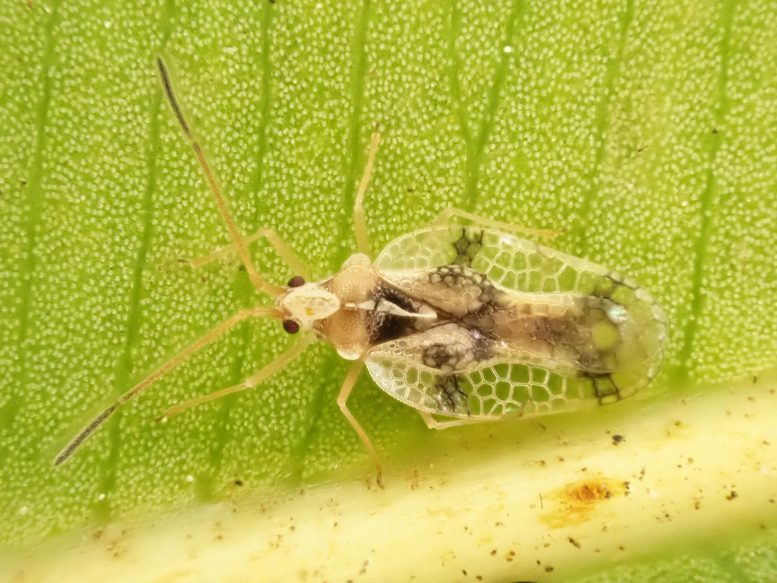
Jun Souma and Naoyuki Nakahama identified a new species of lace bug on the Ogasawara Islands, a remote archipelago located 900 to 1,000 kilometers south of Tokyo, Japan.
The researchers found that insects previously grouped as a single species actually consist of two distinct types based on genetic and physical differences. The team analyzed 52 specimens using MIG-seq, a method that provides DNA data from across the genome.
Their results showed that populations on the Chichijima and Hahajima island groups are genetically distinct. While the insects on the Chichijima group feed on both a native plant and an introduced tree, the Hahajima population feeds exclusively on a native plant and lacks certain dark markings on its pronotum, the plate behind its head. The researchers named the new Hahajima population Omoplax sandoru.
The study also suggests that the human introduction of the Calophyllum inophyllum tree may be driving the evolution of the Omoplax desecta species. However, the researchers noted that similar appearances and shared food sources do not always mean two insects are closely related. They could not obtain DNA from two rare species, which leaves some gaps in their understanding of how these insects reached the islands and diversified.
Selected and summarized by local AI How we work
More in Discovery

Cheruvayal Raman preserves fifty traditional rice varieties in Kerala
thelogicalindian.com · 11 Nov 2026
Researchers analyze ancient Egyptian cat skulls from Beni Hassan
derstandard.at · 11 Nov 2026

Museum adds soundscapes to romanesque paintings to reconnect art with origins
vilaweb.cat · 12 Nov 2026