Ancient crocodile fossil reveals possible camouflage
Summary and headline written by AI from the source article. How we work
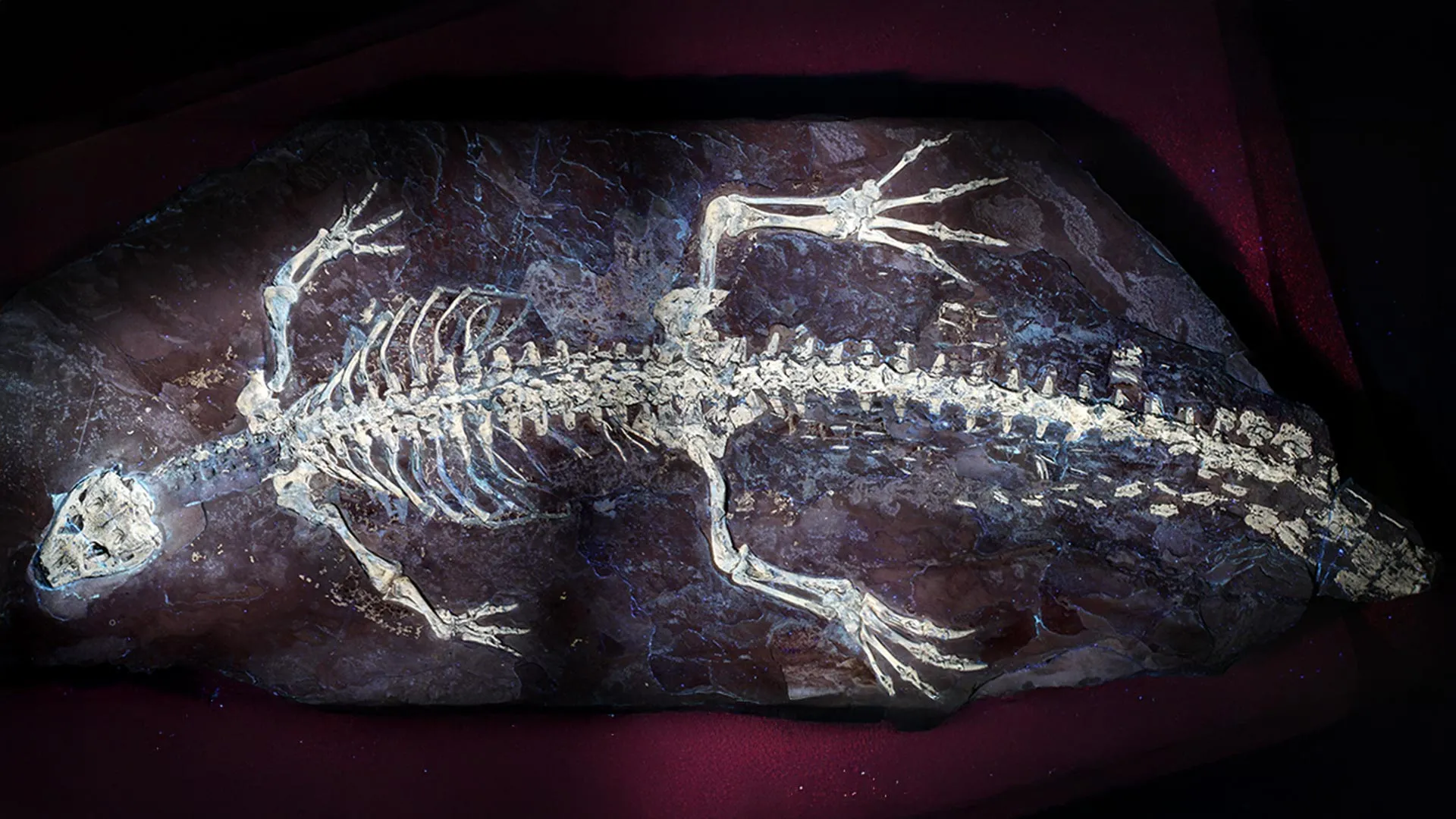
Researchers from the Institute of Industrial Science, The University of Tokyo, and the Institut Català de Paleontologia Miquel Crusafont studied a 125-million-year-old crocodile relative, Montsecosuchus depereti, discovered in Catalonia, Spain. The team examined the fossil using ultraviolet light, which revealed preserved skin, potential sensory organs, and details of its respiratory system. They found scales varying in size and shape across the animal’s body and noted the absence of a tail fin seen in modern crocodiles.
The ultraviolet light also highlighted possible sensory organs within scales around the crocodile’s neck, limbs, and tail, which may have detected touch, water pressure, temperature, and chemical signals. Researchers believe the animal possessed an advanced respiratory system similar to those of present-day crocodiles, indicating adaptation to a semi-aquatic lifestyle. Most notably, the team observed alternating light and dark bands on the fossil’s tail under UV light.
They propose these bands represent a camouflage pattern that would have broken up the crocodile’s outline, making it harder to see. If confirmed, Montsecosuchus would be the oldest known crocodylomorph with preserved coloration. The fossil came from the Pedrera de Meià site, a location known for its exceptionally well-preserved fossils.