Ancient fish developed diverse jaws to crush different prey
Summary and headline written by AI from the source article. How we work
Researchers from Flinders University in Australia studied fossils of placoderms, ancient, armored fish, to understand how their jaws evolved.
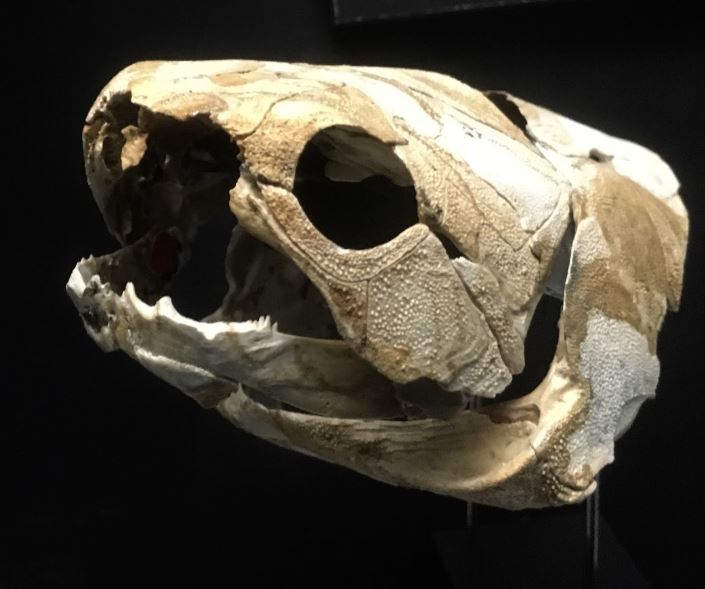
The team examined eight placoderm species from the 385-million-year-old Gogo fossil formation in western Australia, a former marine ecosystem. They used CT scans and surface scans to create 3D models of the fish jaws and then simulated how the jaws functioned. The analysis revealed that placoderms weren’t uniform in their jaw structure.
Smaller placoderms, like Rolfosteus canningensis, possessed smooth, flat dental plates suited for crushing smaller prey. Larger placoderms, such as Kimberleyichthys sp., had bony crests with raised, tooth-like structures. Scientists believe the larger fish needed more calories and therefore developed jaws capable of breaking apart larger, hard-shelled prey. They compared the crest of Kimberleyichthys to medieval weapons like war hammers, designed to puncture and crush armor, while the smaller Rolfosteus had jaws similar to blunt crushing weapons with sharp edges.
This research adds to the understanding of how ancient fish species occupied different ecological niches during the Devonian period, a time known as the “Age of Fishes,” and contributes to the broader picture of vertebrate evolution, including the lineage leading to humans.