Ancient Etruscan inkwell provides clues to undeciphered language
Headline and summary by local AI
Archaeologists and researchers study a 2,600-year-old terracotta vase shaped like a cockerel to better understand the ancient Etruscan language.
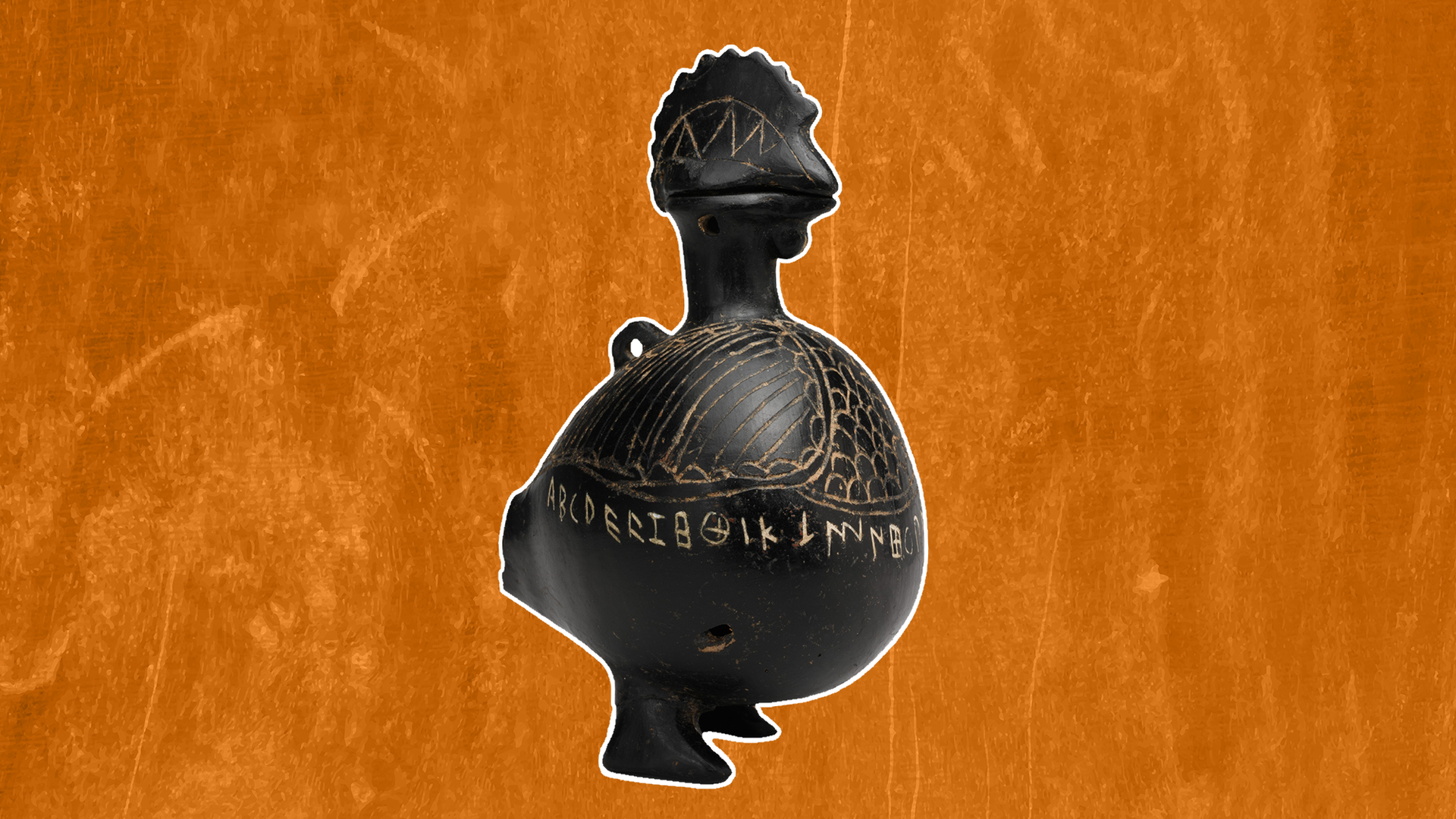
The vase, which stands just over 4 inches tall, is currently held in the collection of the Metropolitan Museum of Art in New York City. The object is a black-glazed ceramic inkwell made by the Etruscans, a pre-Roman society in Italy, between 650 and 600 B.C.
It features a bird shape with human feet and a head that served as a stopper. The vessel was crafted using a bucchero firing method, a technique that deprived the kiln of oxygen to cause the clay to absorb carbon. Researchers believe the item may have been used by an individual learning to write. The body of the cockerel contains an abecedarium, which is a sequential list of the 26 letters of the Etruscan alphabet.
While the alphabet was adopted from a regional version of the Greek alphabet, the language remains only partially understood. Experts note that the vase contains one error where a person inscribed the letter S twice instead of using an X. The vase helps experts decode the language because it preserves the specific order of the early alphabet. Although more than 10,000 inscriptions have been found, the lack of long-form literature makes a full translation difficult.
The vase may have originated from a grave in a cemetery near Viterbo, an ancient Etruscan town near modern-day Rome.
Selected and summarized by local AI How we work