Roman glass with Egyptian blue pigment found in Portugal
Headline and summary by local AI
Researchers from the Universidade Nova de Lisboa are studying Roman remains discovered in a necropolis in Alcácer do Sal, Portugal.
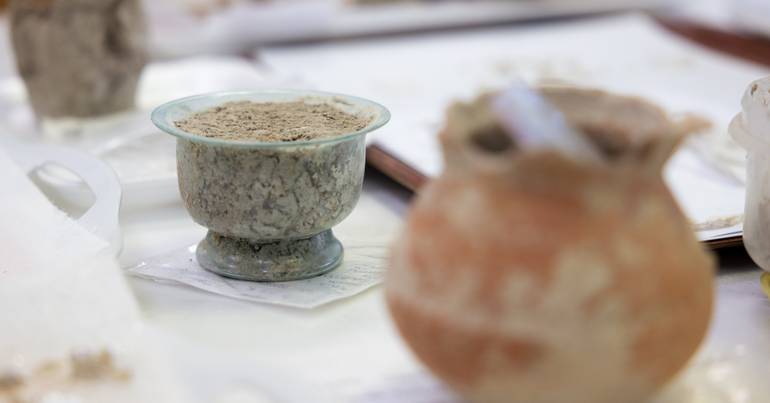
The discovery includes a glass object decorated with Egyptian blue, a pigment that was the first to be synthesized in antiquity. The archaeological company ERA Arqueologia found the artifacts in a cremation necropolis belonging to the ancient Roman city of Salacia, located in the Setúbal district.
The team identified various sets of glass and ceramic objects within the graves, some of which remain in a remarkable state of preservation. Inês Coutinho, a researcher at the university, noted that the 2,000 year old glass pieces prompt questions about what society chooses to preserve. Paula Pereira, an archaeologist from ERA Arqueologia, stated that the presence of the pigment provides scientific importance to the find.
She explained that the discovery helps researchers understand production technologies and the movement of raw materials across the Roman Empire. The variety of materials suggests that the local population had access to long distance trade routes. This indicates that the residents of Salacia maintained commercial and cultural contacts with different regions of the Roman Empire, including territories in the East.
The research team, which includes students and partners from the Universidade de Granada in Spain, aims to further explore local consumption habits and funerary practices.
Selected and summarized by local AI How we work