Surgeons perform first laparoscopic hip correction in Europe
Headline and summary by local AI
Doctors at the Regina Margherita children's hospital and the Cto in Turin, Italy, performed the first laparoscopic surgery in Europe to correct a congenital hip deformity.
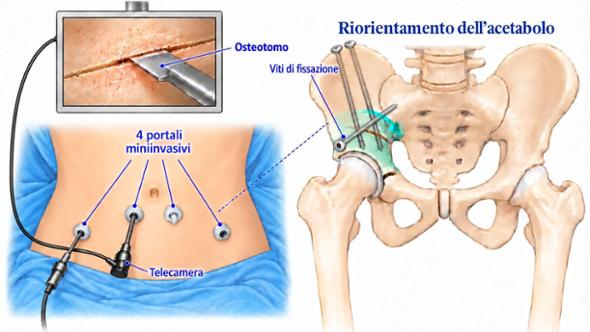
The surgical team, including Alessandro Aprato, Matteo Giachino, Michele Nardi, and Andrea Audisio, used a minimally invasive endoscopic technique to treat a 17 year old patient named Chiara. The procedure addresses hip dysplasia, a condition where the acetabolo, the pelvic cavity that holds the head of the femur, does not properly cover the bone.
This deformity can lead to early-onset osteoarthritis. The surgeons performed a periacetabular osteotomy by making controlled cuts in the bone to reposition it. They then secured the bone with screws to ensure it covers the femur more effectively, which helps distribute weight more evenly and reduces pain. The laparoscopic method allows doctors to perform the surgery through small incisions using a camera to view the operative site. This approach avoids the large surgical exposure required by traditional open-air surgery.
The medical team expects this technique to reduce postoperative pain, minimize scarring, and speed up initial recovery. The operation resulted from a collaboration between the Department of Pathology and Child Care and the Department of Orthopedics, Traumatology, and Rehabilitation. Adriano Leli, the general director of Regina Margherita-Sant’Anna, said the procedure creates new therapeutic opportunities for children and improves their quality of life.
Livio Tranchida, general director of Città della Salute, noted that the success of the surgery reflects a healthcare model that links different specialized skills to create personalized treatment paths.
Selected and summarized by local AI How we work
Thriving: Health improving, rights advancing, lives getting better.
More in Thriving

Argentina completes transfer of prisoners from Villa Devoto to Marcos Paz
lanacion.com.ar · 13 Nov 2026

Nigerian intelligence service releases four people and pays compensation
thisdaylive.com · 3 Nov 2026

Kibaha District Council allocates 300 acres for agriculture program
mwananchi.co.tz · 12 Nov 2026