Digital communication normalizes Cypriot dialect in public life
Headline and summary by local AI
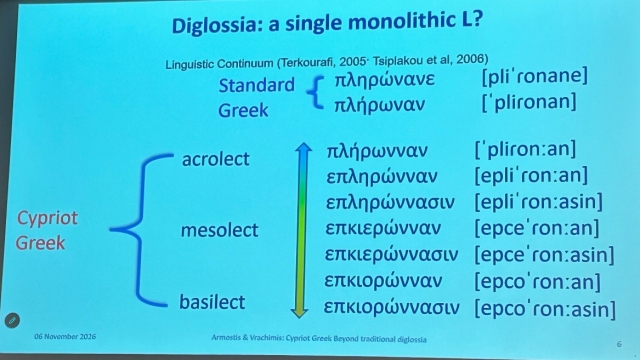
Researchers Spyros Armostis and Manos Vrachimi conducted a study on the evolution of the Cypriot dialect and its role in the modern public sphere.
Spyros Armostis, an Associate Professor of Linguistics at the University of Cyprus, presented the findings at an international conference organized by the Institute of Modern Greek Studies. The research explores how the dialect moved from being restricted to informal settings to gaining status in public discourse.
The study shows that while Standard Modern Greek remains the primary choice for formal administration and official documents, the Cypriot dialect is increasingly accepted in social media, advertising, and public protests. Participants in the research expressed a high level of support for expanding the use of the dialect. Specifically, 89.0% of respondents supported expanding its use in oral speech, while 79.6% supported its expansion in written forms.
Technological shifts in the late 1990s and early 2000s, such as SMS messaging and early blogging, created a new form of communication where users typed exactly as they spoke. The use of Greeklish, a system of writing Greek using Latin characters, allowed people to record unique phonetic features of the Cypriot dialect that standard Greek letters could not easily capture.
This digital shift helped normalize the dialect in literature, rap music, and even in the translation of high-level political texts like the Communist Manifesto.
Selected and summarized by local AI How we work