Oxford mathematician challenges 2,000-year-old theory of the Parthenon’s design
Summary and headline written by AI from the source article. How we work
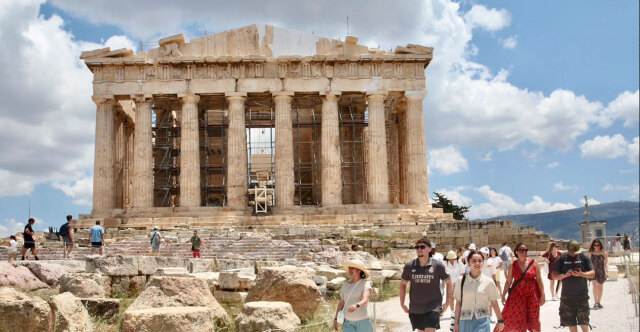
A mathematician at the University of Oxford, Alain Goriely, used mathematical models to question a long-held belief about the Parthenon in Athens, Greece. For centuries, scholars have argued that subtle curves in the temple’s structure were intentionally designed to counteract optical illusions and make the building appear perfectly straight.
Goriely’s research suggests that the supposed optical illusions either aren’t scientifically supported or are too minor to be noticed by observers.
The professor traced the origins of the theory back roughly 2,000 years to the writings of Vitruvius, a Roman architect who wrote about Greek architecture centuries after the Parthenon was built. Over time, Vitruvius’ interpretations became standard in architectural texts, and gained renewed interest in the 19th century with precise measurements of the temple’s curves. Goriely found at least 12 different theories about these “optical corrections,” but no supporting evidence. Goriely proposes more practical explanations for the curves.
The slight curvature of the Parthenon’s base, for example, could have helped drain rainwater. Similarly, the gently curved columns might have been chosen simply because ancient Greeks considered them more natural and aesthetically pleasing than perfectly straight lines. He notes that the theory of intentional optical correction has become so ingrained in modern understanding of the Parthenon that even artificial intelligence systems now reproduce it.