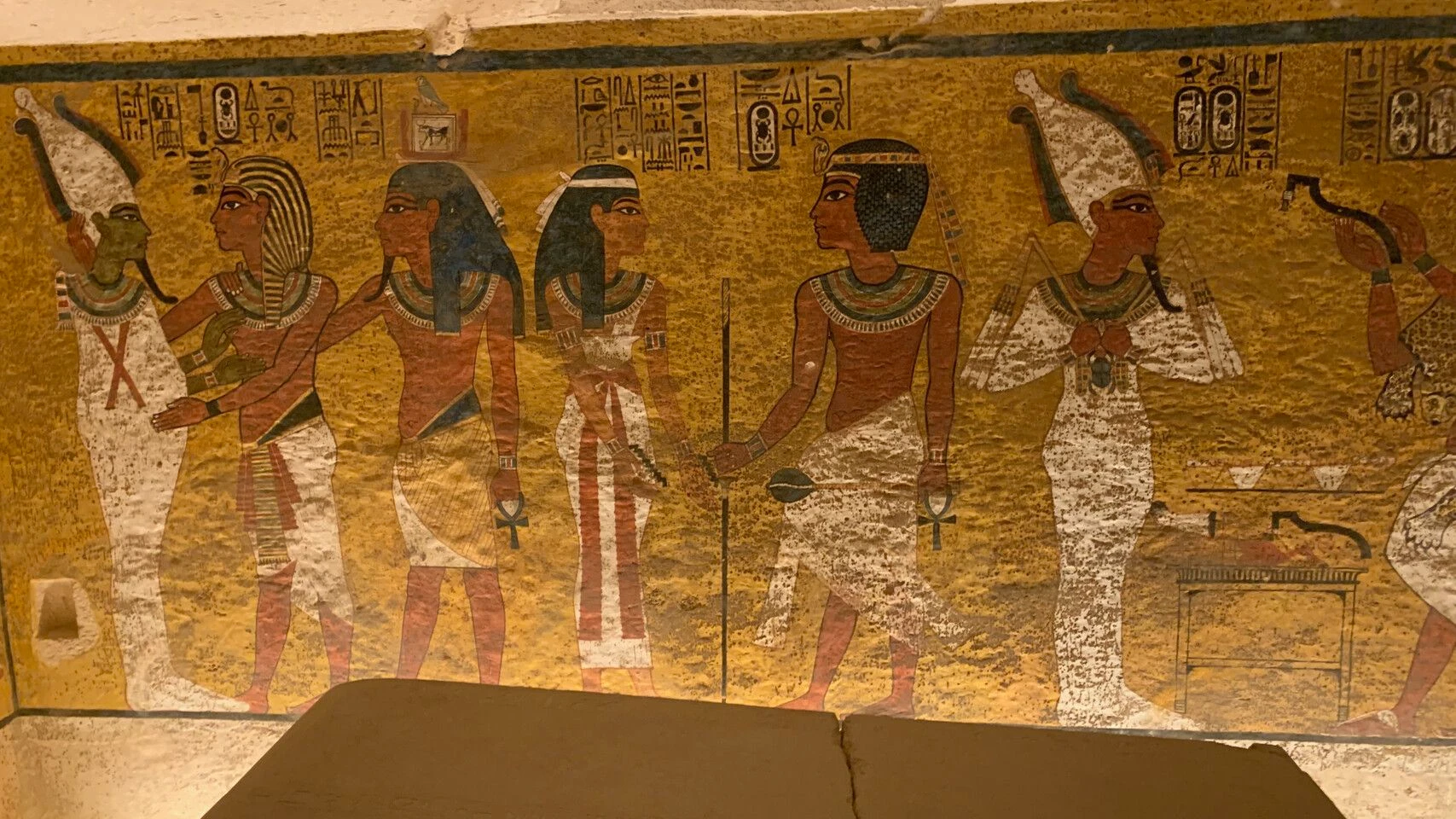
New measurements suggest hidden chambers near Tutankhamun’s tomb
Summary and headline written by AI from the source article. How we work
Nicholas Reeves, a British Egyptologist, and a team including Mamdouh Eldamaty of Ain Shams University in Cairo and engineer George Ballard, have presented new data suggesting the presence of hidden chambers near the tomb of Tutankhamun in Egypt’s Valley of the Kings.
For eleven years, Reeves has believed that the Egyptian queen Nefertiti may be buried in a concealed chamber within Tutankhamun’s tomb, a hypothesis initially supported by some ground-penetrating radar scans but later questioned.
Recent measurements conducted in 2023 and 2024 employed ground-penetrating radar, electrical resistance tomography, and microgravimetry, measuring tiny changes in gravity to map underground density, to analyze the area north of Tutankhamun’s tomb. The team identified thirteen or fourteen rectangular anomalies aligned with the known tomb chambers, indicating a possible system of five or six chambers located approximately 20 to 25 meters away and up to 1.5 meters deeper.
While the researchers cannot definitively confirm the existence of these chambers, they found no evidence from geophysical studies to disprove it. Eldamaty, Ballard, Reeves, and their colleagues propose drilling small boreholes, seven to eight centimeters wide, into one of the suspected chambers, specifically “Anomaly 10,” to insert 360-degree cameras and investigate the space.
They suggest that if confirmed, this complex could potentially hold the remains of Nefertiti, the possible stepmother of Tutankhamun, whose tomb and mummy have never been definitively located. However, the condition of any potential burial remains uncertain, as the chambers may have been damaged by water over the past 3300 years or even repurposed for Tutankhamun himself.