Solar projects with battery storage reach 16% of new installations
Headline and summary by local AI
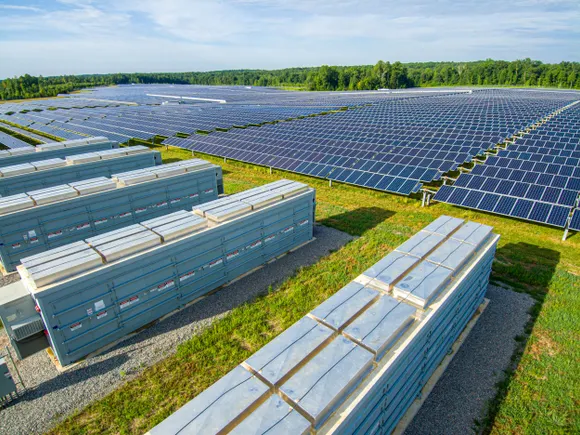
The U.S. Energy Information Administration reported that 16% of new solar projects deployed in the United States included co-located battery storage as of September.
This figure represents about 41 GW of capacity and is expected to reach 19% by the end of the year. The agency predicts that this share will likely exceed 30% within the next two years. Operators use these combined systems to manage electricity output based on wholesale prices.
Because solar contributions often cause prices to drop when production is high and rise when it is low, plants with batteries can store power and release it to maximize value. The U.S. Energy Information Administration noted that Southwest states, including Arizona, New Mexico, and Nevada, have higher levels of co-located utility-scale solar and battery capacity than the national average.
The Solar Energy Industries Association reported that solar generation grew by 421% in Texas and 90% in California between 2021 and 2026. During that same period, battery storage capacity in Texas grew more than 26-fold and nearly sevenfold in California. The agency also noted that both the California Independent System Operator and the Electric Reliability Council of Texas reported lower average wholesale electricity prices compared to 2021.
Lawrence Berkeley National Laboratory found that 436 co-located solar-plus-storage projects existed in the United States by the end of 2025. These projects provided 29 GW of solar capacity and nearly 17 GW of storage capacity. Furthermore, solar-plus-storage facilities make up 86% of proposed hybrid facilities in the interconnection queue, which totals nearly 361 GW of planned capacity.
Selected and summarized by local AI How we work