Shipwrecks from the Goryeo Kingdom reveal ancient trade routes
Headline and summary by local AI
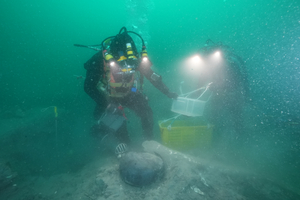
Researchers from the National Research Institute of Maritime Heritage identified two shipwrecks from the Goryeo Kingdom off the coast of Mado in South Chungcheong Province, South Korea.
These vessels, designated Mado No. 5 and Mado No. 6, provide new evidence regarding how the kingdom transported goods to its capital. Excavations at the Mado No. 5 site yielded 54 artifacts, including a stone anchor, wooden timbers, and bundles of celadon, a type of traditional pottery.
The team also found 26 wooden tablets with inscriptions that detail the cargo's origin and the ship's scheduled departure. By combining these inscriptions with radiocarbon dating, researchers determined the ship likely departed in the spring of 1208 after collecting goods in the preceding year. The findings suggest that Mado No. 5 belonged to the same fleet as Mado No. 1, a vessel discovered in 2009.
Both ships carried goods from the southwestern Jeolla Province to Gaegyeong, the capital of the Goryeo Kingdom, which is now located in North Korea. One tablet from Mado No. 5 even features handwriting nearly identical to a tablet from Mado No. 1, suggesting the same person may have recorded the shipments. A separate investigation of an underwater anomaly revealed Mado No. 6.
A test excavation at this site produced about 20 artifacts, including a stoneware kundika, a ritual water vessel, and wooden tags. These tags identify the sender of the cargo as a local administrative clerk from Saju, a location that once housed one of 13 government warehouses for grain taxes. The institute intends to continue work on Mado No. 5 in 2027 and conduct a larger study of Mado No. 6.
Selected and summarized by local AI How we work