A 1,000 year old royal sarcophagus returns to Vyšehrad castle
Headline and summary by local AI
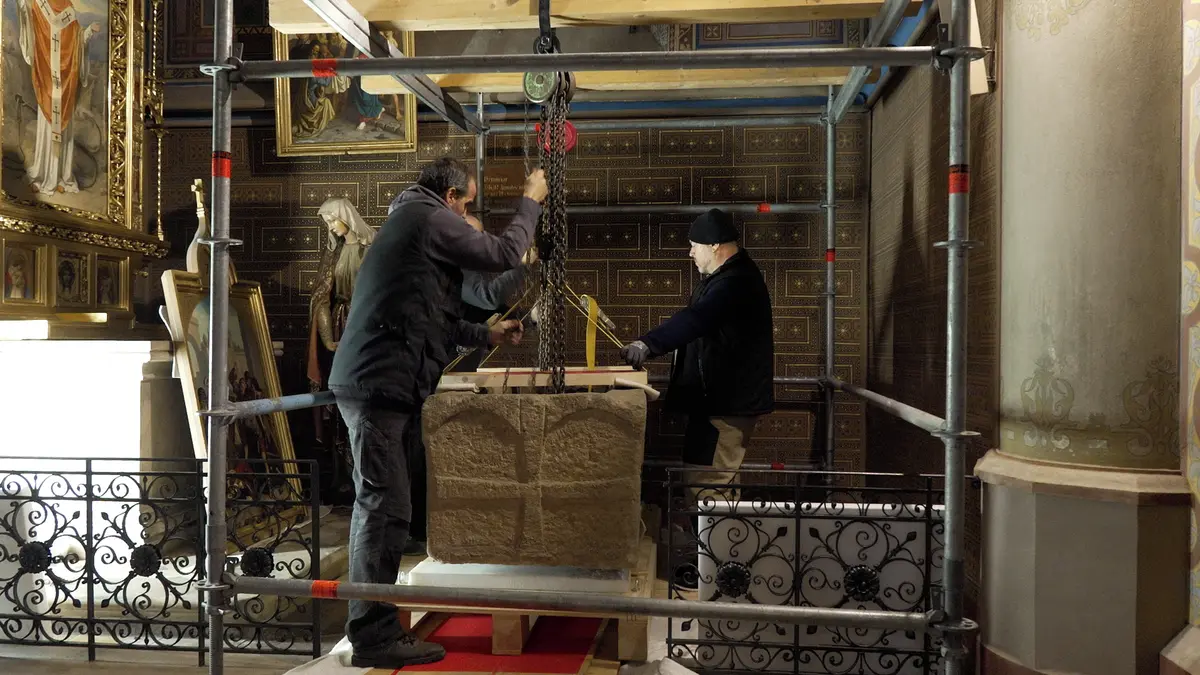
Workers moved a massive stone sarcophagus back to its original location in the Chapel of St. Clement at Vyšehrad, a historic castle in Prague, Czech Republic.
The artifact remained in its place for decades until it was transported to the National Museum for a special exhibition on the Přemyslid dynasty. Following the exhibition, a specialist firm used a crane and scaffolding to return the stone chest to the chapel.
The sarcophagus, which weighs about 1.5 tons, sits on new pedestals so visitors can view it more easily. While the stone chest is a significant historical artifact, it no longer contains any remains. Historians believe the sarcophagus was created between the late 11th and early 12th centuries, but they cannot confirm who it was built for. Several theories exist regarding its original owner. Some experts suggest it belonged to Vratislav II, the first Czech king, who died in 1092.
Others suggest it may have belonged to Queen Svatava or her son, Soběslav I. Because three sides of the chest feature a Greek cross while one side does not, scholars believe it was meant to stand against a wall. The sarcophagus is often associated with Saint Longinus, a Roman soldier whose relics were brought to Vyšehrad in the early 15th century. The interior of the stone chest shows sophisticated medieval craftsmanship.
It features a hollowed area designed to hold a head in an elevated position and two drainage holes to allow bodily fluids to escape during decomposition. The exterior is decorated with 14 arches that symbolize the path of the Way of the Cross.
Selected and summarized by local AI How we work


