European fossils confirm Diplodocus lived beyond North America
Summary and headline written by AI from the source article. How we work
Spanish paleontologists discovered the first evidence that diplodocus, long-necked herbivorous dinosaurs, lived in Europe as well as North America tens of millions of years ago.
The researchers from the Dinópolis Foundation in Teruel, Spain, found the bones near the city of Teruel. They identified 14 tail vertebrae and several bones from the underside of the tail belonging to an individual that lived approximately 150 million years ago during the late Jurassic period.
The team published their findings in the Journal of Vertebrate Paleontology, stating anatomical studies and evolutionary analyses confirmed the specimen from El Castellar, a town near Teruel, about 100 kilometers northwest of Valencia, belonged to the Diplodocus genus. Sergio Sánchez-Fenollosa, the lead author of the study, explained this represents one of the most complete diplodocid fossils ever found in Europe and the first proof of the genus existing outside of North America.
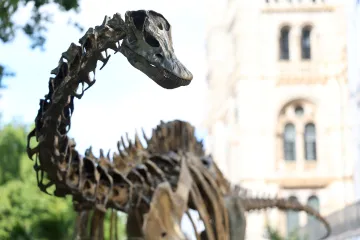
Alberto Cobos, a co-author and the executive director of the Dinópolis Foundation, estimated the individual measured around 25 meters long. This discovery suggests large dinosaurs could have migrated between North America and Europe, likely across temporary land connections as the ancient North Atlantic retreated. Diplodocus, first identified from fossils found in Wyoming, USA in 1877, is known for its long neck, small head, and whip-like tail.