Kazakhstan honors legendary bard Korkyt Ata and ancient history
Summary and headline written by AI from the source article. How we work
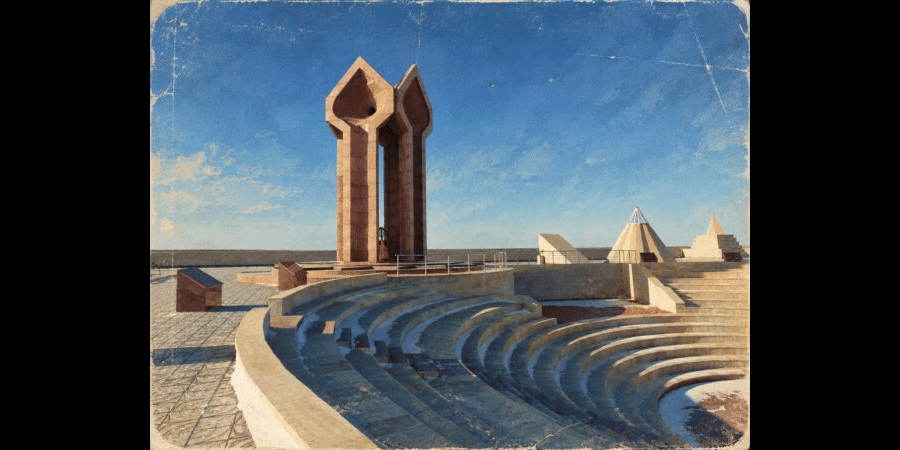
Near the Syr Darya river in Kazakhstan, the Korkyt Ata Memorial Complex commemorates a legendary sage, musician, and storyteller central to Kazakh and wider Turkic traditions.
The monument, built in 1980 and reconstructed in 2014, features 40 metal pipes designed to resonate with the wind, mimicking the sound of the kobyz, a traditional bowed instrument linked to Korkyt Ata.
Korkyt Ata, also known as Dede Qorqud or Dede Korkut in other cultures, travelled seeking a place where death couldn’t find him, according to legend. He ultimately created music as a way to transcend mortality, believing his creations would outlive him. This belief is reflected in the memorial’s design, which evokes a kobyz and produces sound through natural elements. The region surrounding the memorial holds layers of history beyond the legend.
Archaeologists have excavated Zhankent, a medieval city connected to the Oghuz Turkic tribes, and Chirik-Rabat, a fortified settlement dating from the fifth to first centuries BCE. These sites reveal a landscape shaped by shifting river channels and trade routes, where nomadic and settled cultures met. In 2018 UNESCO recognised the epic culture, folk tales, and music associated with Korkyt Ata as an Intangible Cultural Heritage of Humanity, jointly nominated by Kazakhstan, Azerbaijan, and Turkey.


