UK government blocks Export of rare Mughal calligraphy collection
Headline and summary by local AI
The UK government blocked a request to export two volumes of Mughal calligraphy to keep the items in the country.
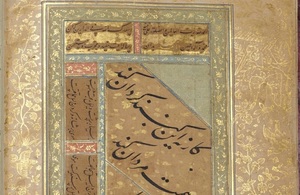
The volumes contain work from the 16th to mid-19th century Mughal dynasty, a period of rule over much of the Indian subcontinent. These specific pieces date back to approximately 1595 to 1605 and were likely created in royal workshops in Lahore or Agra for Emperor Akbar or his son, Prince Salim.
The government placed a temporary export ban to allow museums and galleries time to raise funds for an acquisition. Heritage Minister Baroness Twycross stated that the works are extraordinarily rare and hold secrets for researchers. The collection features 29 leaves with gold decorations of plants and animals, showcasing the skills of famous royal calligraphers like Muhammad Hussain Kashmiri and Abd al-Rahim al-Haravi.
The Reviewing Committee on the Export of Works of Art and Objects of Cultural Interest recommended the ban because the items have outstanding aesthetic importance. The committee noted that the volumes are vital for studying Mughal studio practices and international diplomacy. The government deferred the export license until 15 February 2027 to give the public and researchers a chance to study the 400 year old works.
The owners can consider offers to sell the volumes at a recommended price of £900,000 at the end of the first deferral period. If an agreement is reached, a second deferral period of four months will begin.
Selected and summarized by local AI How we work
More in Discovery

Lack of stone resources limited Paleolithic human expansion in Arabia
eldiario.es · 14 Nov 2026

New Basque Cuisine movement celebrates 50 years of culinary innovation
mexiconewsdaily.com · 23 Nov 2026

Artist Anthony Daley presents abstract expressionist paintings in London
protothema.gr · 23 Nov 2026