Researchers use AI to turn flat photos of Li brocade into 3D digital garments
Headline and summary by local AI
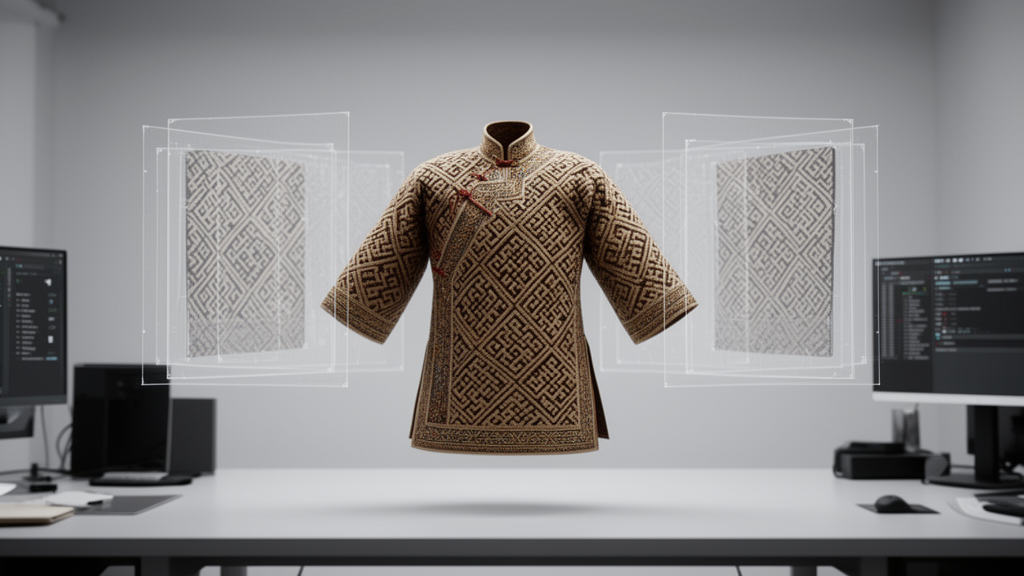
Researchers engineered a cross-modal deep learning framework to transform two-dimensional photographs of traditional Li brocade textiles into wearable, three-dimensional digital garments.
Li brocade is a traditional weaving practice and symbolic motif from China that UNESCO listed as an intangible cultural heritage in need of urgent safeguarding in 2009.
Because these textiles are often only preserved in flat photos or delicate museum pieces, the team developed a two-stage generative workflow to reconstruct the garments without losing intricate cultural motifs or creating geometric distortions. The team gathered a dataset by conducting field research in Li settlements across Wuzhishan City, Baisha County, and Ledong County. They captured high-resolution photos of 856 authentic specimens and used a structured light scanner to document physical garment geometries.
To train the system, they also created 12,400 synthetic samples by simulating fabric behavior, such as density and bending stiffness, based on laboratory tests of 36 handwoven textile swatches. The framework uses a specialized network to separate texture generation from body deformation. One part of the system focuses on synthesizing surface textures, using attention mechanisms to ensure culturally significant elements like headdresses or frog patterns remain clear. A second part predicts how the garment fits on a parametric human avatar.
This process allows the system to generate 3D models much faster than previous diffusion-based methods while maintaining the symbolic integrity of the original designs.
Selected and summarized by local AI How we work
Discovery: Archaeology, new knowledge of art, culture and history, forgotten history uncovered, something lost restored.