Historical shifts in Chinese food culture reflect climate and social changes
Headline and summary by local AI
Historical shifts in Chinese food habits demonstrate how climate, migration, and social changes shaped the nation's culinary traditions over centuries.
Miranda Brown, a professor of Chinese studies at the University of Michigan, explains how specific food items and dining customs in China evolved to meet environmental and social needs. One such example is Milik, a dried dairy product similar to the Mongolian Aarul.
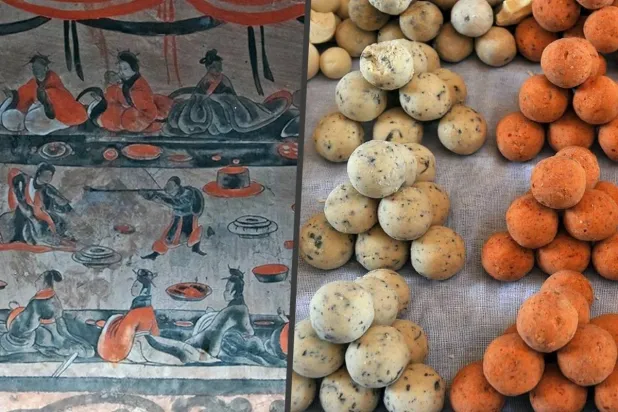
Residents in northern China produced Milik during the Middle Period, which lasted from 100 to 1500 AD, to provide a durable source of protein during harsh winters. To create the food, people mixed fermented milk with spring water, boiled it in open pots to evaporate moisture, and dried the resulting paste into hard balls. While Milik became less common in China as populations moved south toward agricultural resources, it remains a staple in parts of Central Asia and Xinjiang.
Dining customs also underwent a major transformation from individual portions to shared communal tables. A mural from the Han Dynasty, dating between 202 BC and 220 AD, shows people sitting on the ground with their own separate vessels. Brown suggests this individual style may have reflected social hierarchy or served as a way to show respect to guests by separating portions. These rigid social structures weakened during the period of the Sixteen Kingdoms, from 304 to 439 AD.
Internal migrations during this turbulent time helped spread communal dining habits across different regions. The adoption of shared meals was further supported by the invention of the Huchuang, a foldable wooden chair. This furniture allowed people to sit more comfortably, facilitating the rise of the communal table as a centerpiece of Chinese social life. These changes show that Chinese cuisine is a reflection of how communities adapted to their surroundings and organized their social lives over thousands of years.
Selected and summarized by local AI How we work


